
Diversity in Clinical Trials: Understanding Representation and Gaps
Clinical trials are the cornerstone of medical research, helping to determine the safety and efficacy of treatments. However, recent studies highlight significant disparities in who participates in these trials, which can have serious implications for healthcare outcomes across different populations.
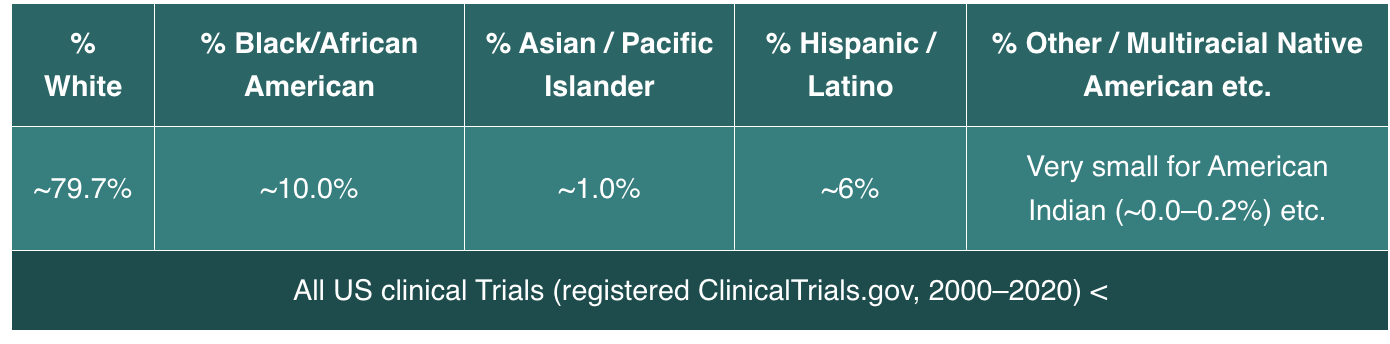
A 2022 cohort study by Turner et al., published in Lancet Regional Health America, analyzed race and ethnicity reporting across all U.S. clinical trials registered on ClinicalTrials.gov between 2000 and 2020. The study found that the majority of trial participants were White, while other racial and ethnic groups were significantly underrepresented:
Source: Turner BE, Steinberg JR, Weeks BT, Rodriguez F, Cullen MR. Race/ethnicity reporting and
representation in US clinical trials: a cohort study. Lancet Reg Health Am. 2022 Jul;11:100252. doi:
10.1016/j.lana.2022.100252. Epub 2022 Apr 10. PMID: 35875251; PMCID: PMC9302767.
These figures reveal a stark imbalance. Black or African American individuals accounted for only about 10% of participants, while Hispanic/Latino representation was around 6%. Participation of Asian/Pacific Islander populations remained extremely low at approximately 1%, and Native American representation was nearly negligible.
Why Representation Matters
Underrepresentation in clinical trials can lead to treatments that are less effective or riskier for certain populations. Biological responses to medications, side effects, and disease prevalence can vary across racial and ethnic groups. When trials fail to include a diverse population, researchers may miss critical insights needed for equitable healthcare.
Barriers to Participation
Several factors contribute to low participation rates among minority populations:
Historical mistrust: Past unethical research practices, such as the Tuskegee Syphilis Study, have created lingering distrust.
Access issues: Limited awareness of trials, transportation difficulties, and financial constraints can prevent participation.
Cultural and language barriers: Lack of culturally competent outreach and materials in multiple languages can deter enrollment.
Steps Toward Equity
Addressing these gaps requires intentional strategies:
Community engagement: Building relationships with local organizations to raise awareness and trust.
Inclusive recruitment practices: Designing studies that actively reach underrepresented populations.
Policy initiatives: Regulatory bodies encouraging or requiring diverse enrollment in trials.
Conclusion
Diversity in clinical trials is not just a matter of fairness—it’s a scientific necessity. Increasing representation ensures that treatments are safe, effective, and applicable to all populations. As the medical community moves forward, closing these gaps must be a top priority to achieve truly equitable healthcare outcomes.
Reference:
Turner BE, Steinberg JR, Weeks BT, Rodriguez F, Cullen MR. Race/ethnicity reporting and representation in US clinical trials: a cohort study. Lancet Reg Health Am. 2022 Jul;11:100252. doi: 10.1016/j.lana.2022.100252. Epub 2022 Apr 10. PMID: 35875251; PMCID: PMC9302767.
